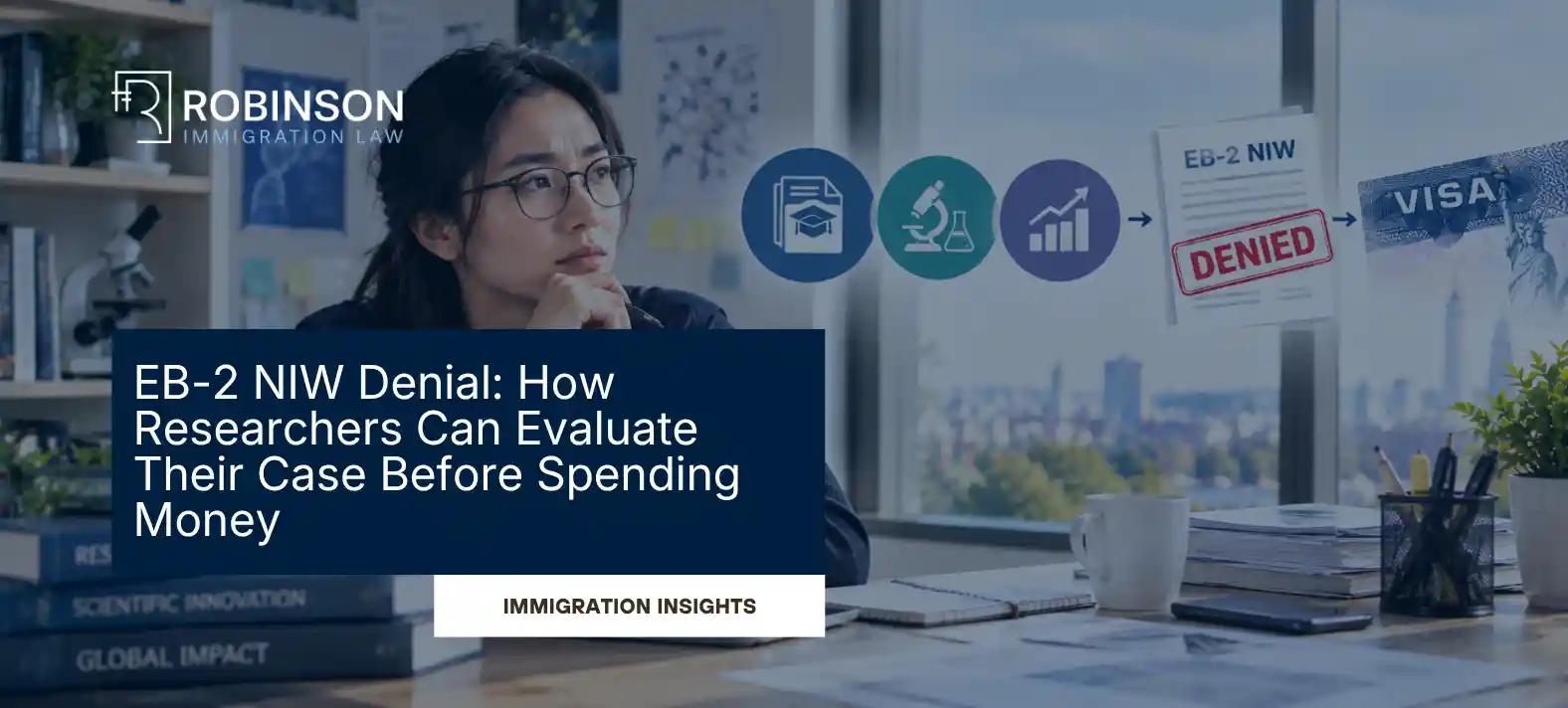
What if you spend thousands of dollars and months of work on an EB-2 NIW petition, only to have it denied?
For researchers, that fear is real. You’ve likely spent years earning your degree, publishing, and building expertise. Now you’re weighing filing fees, attorney costs, and your career timeline against approval rates that have fallen sharply since 2022. Many researchers delay filing for months because they can’t tell whether their case is strong enough.
That uncertainty is the problem this guide solves. The EB-2 NIW is still one of the best green card paths for researchers. You can self-petition, skip employer sponsorship and PERM labor certification, and get a decision in 45 business days with premium processing. The key is knowing your odds before you spend.
This guide covers how common denials are, what they cost, why researchers’ petitions fail, and a step-by-step way to evaluate your case before filing.
How Common Is An EB-2 NIW Denial Right Now?
The Latest USCIS Numbers
According to USCIS data, EB-2 NIW denials have risen sharply in recent years:
| Period | Approval Rate | Denial Rate |
|---|---|---|
| FY2022 | 95.7% | 4.3% |
| FY2024 | 71.0% | 29.0% |
| FY2025 | 55.2% | 44.8% |
| FY2026 Q3 | 55.3% | 44.7% |
Why Researchers Shouldn’t Panic
These figures include every petition USCIS decides, including rushed filings with template letters and vague endeavors. They don’t reflect how a well-prepared research petition performs. Researchers often have strong evidence, like publications, citations, and peer-reviewed work. The question is whether they present that evidence the way USCIS expects.
What Does an EB-2 NIW Denial Actually Cost You?
Fees You Won’t Get Back
USCIS doesn’t refund filing fees after a denial. For a self-petitioner, government fees include the Form I-140 filing fee ($715 on paper or $665 online) and a $300 Asylum Program Fee. Optional premium processing adds $2,965. If you filed a green card application at the same time, you also lose those fees. Attorney fees are on top of all of this.
Lost Time and Career Momentum
The higher cost is often time. A denial after more than a year of standard processing can delay your green card, affect job decisions, and leave you without a priority date. For researchers from India or China, every month matters because of long visa backlogs.
Why Do Researchers’ EB-2 NIW Petitions Get Denied?
Most denials come down to how you argue the case, not the researcher’s credentials. USCIS judges every petition under the three-prong Matter of Dhanasar test.
A Vague Proposed Endeavor
“Continuing my research in machine learning” isn’t specific enough. USCIS wants to know exactly what you’ll work on and why it matters, such as “developing machine learning tools to detect early-stage sepsis in rural hospitals.”
National Importance That Isn’t Proven
Many petitions describe the field’s importance instead of the endeavor’s. The USCIS Policy Manual makes clear that the specific work must have broad impact, beyond a single lab, university, or employer.
A Weak Case for Being Well Positioned
Officers look for proof that you can actually advance the endeavor. A list of publications without context about their influence, adoption, or follow-on work often falls short.
Generic Recommendation Letters
Letters from your advisor and lab mates saying your work is “important” carry little weight. Letters from independent experts who explain specific contributions and how others use your work are far stronger.
Skipping the Third Prong
Many petitions barely address why waiving the job offer requirement benefits the U.S. A clear argument for prong three, such as urgency, the nature of research work, or the difficulty of labor certification, can make the difference.
How Can You Evaluate Your EB-2 NIW Case Before Filing?
Use these steps to judge your readiness before you spend money.
Confirm Your Basic EB-2 Eligibility
You must qualify for EB-2 with a master’s degree or higher, a bachelor’s plus five years of progressive experience, or exceptional ability. Your degree must relate to your proposed endeavor.
Test Your Proposed Endeavor
Write your endeavor in two sentences. If it describes your job title or field instead of specific work with a clear outcome, refine it before going further.
Score Your Evidence Against Each Prong
| Dhanasar Prong | Strong Evidence | Red Flags |
|---|---|---|
| 1. Merit and national importance | Federal funding, government reports, broad industry or public health impact | Only describes why the field matters |
| 2. Well positioned | Citations, follow-on research, grants, invitations to review or speak, adoption of your work | Publications listed with no evidence of influence |
| 3. Balance favors waiver | Clear explanation of urgency and why labor certification is impractical | Section missing or only one paragraph |
| Letters | Independent experts citing specific contributions | Only advisors and colleagues using general praise |
If you have more red flags than strong evidence in any row, consider strengthening your case before filing.
Get an Independent Review
It’s hard to judge your own work objectively. An experienced immigration attorney can spot weak areas, compare your profile with recent approvals and denials, and tell you whether to file now or wait.
Not sure you meet the requirements? Read our complete EB-2 NIW guide to review eligibility, the Dhanasar test, and the evidence USCIS expects before you file.
Should You Consider EB-1A or O-1A Instead?
When EB-1A Is the Better Choice
The EB-1A is a self-petitioned green card for people with sustained acclaim. It requires meeting three of ten criteria, such as awards, high citation counts, or judging others’ work. EB-1A often has shorter visa backlogs, which matters for researchers born in India or China.
When O-1A Makes Sense
The O-1A is a temporary work visa for people with extraordinary ability. It’s useful if you need U.S. work authorization quickly or are between positions. It requires a U.S. employer or agent.
Filing More Than One Petition
Many researchers file EB-2 NIW and EB-1A together, or use an O-1A while a green card petition is pending. This spreads risk across categories instead of relying on one petition.

What Can You Do If You Still Receive An EB-2 NIW Denial?
A denial isn’t the end of your green card path. Your options include:
- Respond to an RFE or NOID before a final decision. This is your best chance to fix gaps.
- File a motion to reopen or reconsider using Form I-290B within 30 days (33 if mailed).
- Appeal to the Administrative Appeals Office if the officer misapplied the law.
- Refile a stronger petition, since there’s no waiting period after a denial.
- Switch to EB-1A or O-1A if your profile fits better.
How Robinson Immigration Helps Researchers Avoid Costly Denials
The best way to avoid an EB-2 NIW denial is to know where your case stands before you file.
Robinson Immigration Law starts with a free profile evaluation. We review your research, publications, and goals against all three Dhanasar prongs and tell you honestly whether you’re ready. If you’re not, we’ll show you what to strengthen, or whether EB-1A or O-1A is a better fit. From there, we help you:
- Define a specific, defensible proposed endeavor
- Turn your research record into evidence of national importance and impact
- Identify independent experts and shape strong letters
- Respond to RFEs or plan next steps after a denial
We don’t promise approvals. We give you a clear read on your case before you spend money on filing.
FAQs About EB-2 NIW Denial
2. How many citations do I need for an EB-2 NIW?
There's no minimum. USCIS looks at the influence of your work, not a set number. A modest citation count can work if you show how others use, adopt, or build on your research.
3. Can I refile after an EB-2 NIW denial?
Yes. There's no waiting period. You can refile right away with stronger evidence or file a motion or appeal within 30 days of the decision.
4. Does premium processing reduce the risk of denial?
No. Premium processing only speeds up the decision. It doesn't change the evidence standard or your chances of approval.
5. Does an RFE mean my EB-2 NIW will be denied?
No. An RFE asks for more evidence, and a strong, targeted response can lead to approval.
Conclusion
An EB-2 NIW denial is expensive, but it’s often preventable. When you evaluate your case honestly before filing, you can file with confidence, strengthen your evidence first, or choose a better-fitting category.
Robinson Immigration Law will review your research profile, compare your EB-2 NIW, EB-1A, and O-1A options, and tell you exactly where you stand.
Get a free profile evaluation, or speak with an attorney today.