Thinking about applying for a U.S. green card through the EB-2 National Interest Waiver (NIW), but not sure if you qualify? Here’s a free eb-2 niw free evaluation guide to help you find out.
Thousands of skilled professionals, researchers, engineers, physicians, entrepreneurs, and academics ask the same question every year: “Do I actually have a case?” Before you ever talk to an attorney, it helps to sit down and honestly evaluate your own profile against what USCIS is actually looking for.
The EB2 NIW is one of the most powerful self-petition pathways to permanent residency in the United States. But it is also one of the most misunderstood. USCIS sets a high evidentiary bar, and what makes a strong petition is rarely obvious without first doing the groundwork, which is exactly what a self-evaluation is for.
Not sure if you qualify? Request a free EB2 NIW evaluation from Robinson Immigration Law, no cost, no commitment.
Why Self-Evaluate Before You File (or Before You Call an Attorney)
An EB2 NIW petition isn’t just about listing your degrees and achievements; it’s about demonstrating to USCIS that your work benefits the United States in a way that justifies waiving the usual job offer requirement.
That’s a high bar, and it can be tricky to know whether your case truly meets it, especially if you’re still evaluating the differences between EB2 and EB2 NIW, or even EB2 and EB3, for your situation.
Working through a self-evaluation first helps you:
- Spot eligibility gaps early – You’ll know what’s missing before you submit anything to USCIS or even before you book a consultation.
- Save time and money – Filing (or paying for legal help) without understanding your strengths and weaknesses can lead to costly delays or denials.
- Walk into any conversation prepared – whether you decide to self-file or work with a firm, you’ll already know your strongest evidence and the gaps.
- Get a reality check – Sometimes applicants are closer to qualifying than they think. Other times, they need to further develop their case before filing.
A self-evaluation won’t replace a professional review, but it gives you a clear, honest starting point, and it’s the fastest way to know whether it’s worth pursuing this pathway at all.
Understanding the benefits of EB2 NIW, including the ability to avoid employer sponsorship and the PERM process, can also help you determine whether this pathway aligns with your long-term immigration goals.
According to the U.S. Citizenship and Immigration Services, EB-2 NIW applicants must not only qualify as advanced degree professionals or individuals of exceptional ability. But also demonstrate that their proposed endeavor has substantial merit and national importance, that they are well-positioned to advance it, and that waiving the job-offer requirement would benefit the United States.
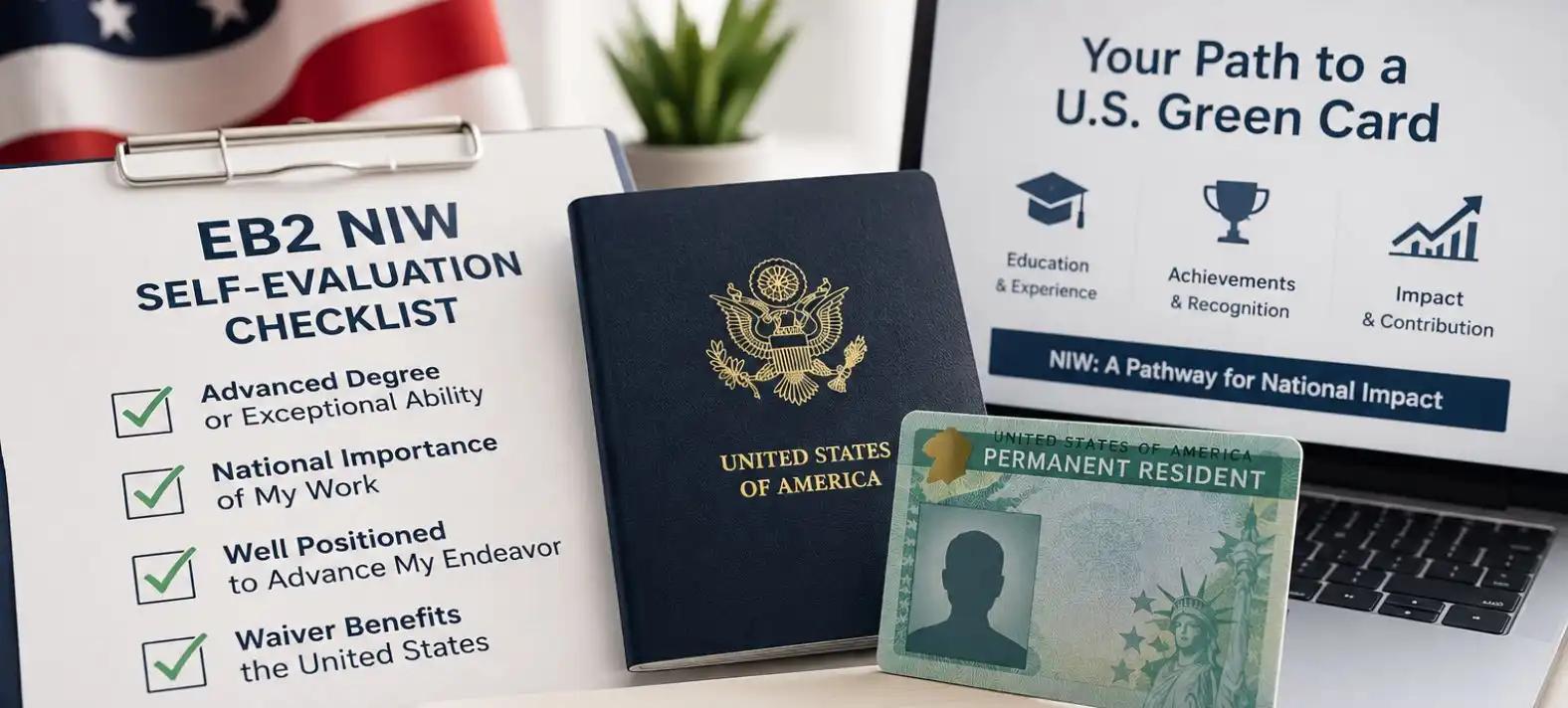
EB-2 NIW Self-Evaluation Checklist: Assess Your Profile Before Applying
Before requesting a professional evaluation, use this checklist to see where you stand. Work through each section and be honest about the evidence you can actually provide today.
Section 1: Education & Credentials – Check at least one
- I hold a master’s degree or higher (or a foreign equivalent)
- I hold a bachelor’s degree plus at least 5 years of progressive experience in my field
- I can demonstrate exceptional ability and expertise significantly above the ordinary in my field
This means you must meet the EB2 standard before the NIW waiver is even considered. If you’re relying on exceptional ability rather than an advanced degree, you’ll need to satisfy at least three criteria in Section 2 below.
Section 2: Exceptional Ability Evidence – Check at least 3 of 6 (if no advanced degree)
- I have an educational diploma in my area of exceptional ability
- I have letters documenting at least 10 years of full-time experience in my occupation
- I hold a professional license to practice my occupation
- I have evidence of remuneration compatible with exceptional ability (salary data, contracts, pay stubs)
- I am a member of a professional association in my field
- I have received recognition for significant professional contributions from peers, government entities, or business organizations
What this means: If you checked three or more items here, you may have a path to exceptional ability classification even without an advanced degree. A free evaluation can confirm whether your specific evidence is sufficient.
Section 3: National Importance of Your Work – Check all that apply
- My work contributes to a field that is essential to the U.S., such as healthcare, STEM, energy, infrastructure, or education
- My research, innovation, or expertise has been adopted at scale, influenced industry standards, shaped public policy, or produced breakthroughs that benefit the country
- I can provide strong, verifiable evidence of impact: publications, citation counts, patents, government endorsements, media coverage, or prestigious awards
- My work benefits the U.S. broadly, not just a single employer or local community
What this means: This is where most petitions succeed or fail. USCIS needs to see a clear connection between your individual work and a national benefit. If you can only check one or two boxes here, focus on building this part of your case before filing.
According to the National Foundation for American Policy (NFAP), the EB-2 NIW has become an increasingly popular pathway for highly skilled professionals because it allows qualified applicants to pursue permanent residency without employer sponsorship.
Section 4: Ability to Advance the Proposed Endeavor Check all that apply
- I have a proven track record of major projects led, industry recognition received, or competitive grants won
- I have a clear, feasible plan to continue my work in the U.S. (job offer, research collaboration, or business venture)
- I can obtain strong recommendation letters from respected professionals who can speak to my skills and impact
What this means: USCIS doesn’t just look at what you’ve done it evaluates whether you’re positioned to keep contributing once in the U.S. All three items here strengthen your case significantly.
What To Prepare For Your EB2 NIW Petition
Once your self-evaluation shows you have a reasonable case, start gathering the documentation you’ll eventually need. Having these ready, even in draft form, makes any next step, whether self-filing or working with an attorney, much faster:
- Updated CV or resume – Detailed, with dates, employers, titles, and measurable accomplishments.
- Diplomas and academic transcripts – including credential evaluations if your degrees are from outside the U.S.
- Proof of experience – Employment verification letters, contracts, or pay stubs showing your professional history.
- Recommendation letters – Ideally from independent experts (not just your direct supervisors) who can speak to the significance of your work and its impact on the field.
- Evidence of impact – Publications, citation records, patents, awards, media coverage, conference presentations, or grant awards.
- Proof of membership or licensure – Professional association memberships, licenses, or certifications relevant to your field.
- A personal statement or proposed endeavor plan – A clear, well-written explanation of what you intend to do in the U.S., why it matters nationally, and how you’re positioned to carry it out.
- Supporting evidence of national importance – Government reports, industry data, or policy documents that connect your specific work to a broader U.S. interest.
- Identity and immigration documents – Valid passport, current visa status, I-94 records, and any prior USCIS filings.
Organizing these early not only speeds up the petition process. But it also often reveals additional gaps or strengths you didn’t notice during the checklist exercise.
Thorough documentation can also reduce the likelihood of receiving a Request for Evidence (RFE) from USCIS, which may delay adjudication and require additional supporting materials.

How To Request A Free Evaluation From Robinson Immigration Law?
Getting started takes just a few minutes. Follow these steps:
Step 1: Select your visa type. Choose the visa category you’re interested in so the team can assess your eligibility accordingly.
Step 2: Enter your professional background and accomplishments. Share details about your profession, qualifications, and any extraordinary ability criteria you can support with evidence.
Step 3: Provide your personal information. Enter your name, email, country of birth, country of residence, and current U.S. immigration status.
Step 4: Indicate your immigration timeline. Let the team know when you’re prepared to begin the process, whether you’re ready now or still gathering information.
Step 5: Add any additional context and submit. Include any extra details about your background or immigration goals, review the privacy and consent notice, and submit your request.
Once submitted, the Robinson Immigration Law team will review your profile and follow up with their assessment.
FAQs On EB2 NIW Self-Evaluation
2. Do I Need A Job Offer To Apply For An EB2 NIW?
No. That is one of the most powerful features of the NIW: you can self-petition without an employer sponsor or PERM labor certification. However, you do need to demonstrate that you have a concrete, viable plan to continue your work in the United States and that your continued presence benefits the country.
3. What Is The Most Common Reason EB2 NIW Petitions Get Denied?
Insufficient documentation of national impact. Applicants often underestimate how important it is to clearly connect their individual work to a broader national benefit, not just to their employer or local community. Strong, independent recommendation letters and well-framed evidence of national importance are consistently the factors that separate successful petitions from unsuccessful ones.
Conclusion
The EB2 NIW is one of the most flexible, employer-independent pathways to a U.S. green card, but it also rewards preparation. The professionals who succeed aren’t always those with the longest CVs; they’re the ones who understand what USCIS is looking for and honestly assess where they stand before they file.
If your self-evaluation leaves you with questions, or you’d like a second opinion before committing to the process.
Robinson Immigration Law also offers a free EB2 NIW evaluation, a quick, no-cost, no-obligation review of your profile by a real member of our legal team.
Request your free evaluation whenever you’re ready, or contact us if you have questions along the way.