What is the Matter of Dhanasar standard, and how does it actually decide your EB-2 NIW case? Matter of Dhanasar is the 2016 precedent decision that created the three-prong test USCIS now uses to evaluate every EB-2 National Interest Waiver (NIW) petition. Under a Matter of Dhanasar NIW analysis, you must show that your proposed endeavor has substantial merit and national importance, that you’re well positioned to advance it, and that waiving the job offer requirement would benefit the United States.
Moreover, this guide explains the standard’s origin, what the prongs require, and how Robinson Immigration helps you build a petition.
What Is Matter of Dhanasar?
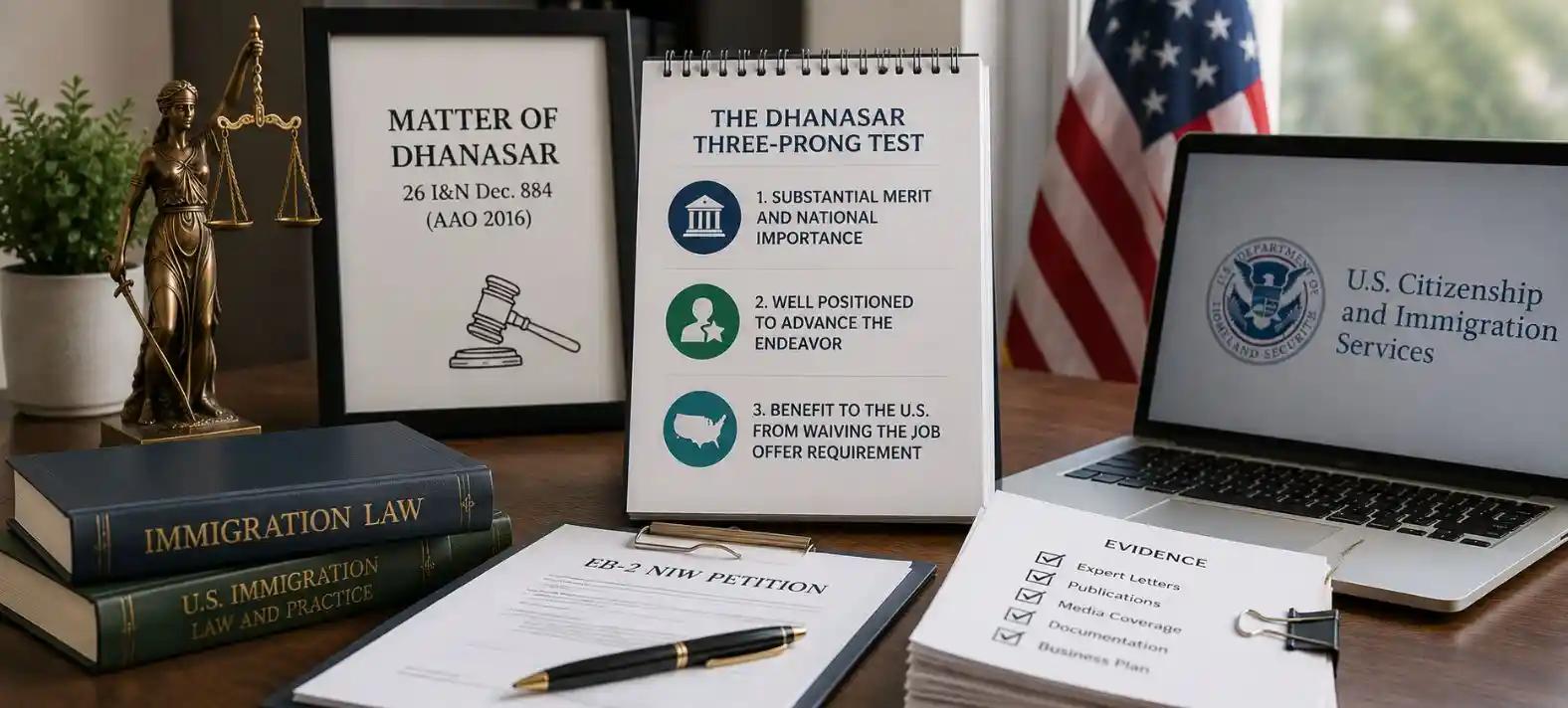
Matter of Dhanasar, 26 I&N Dec. 884 (AAO 2016), is a precedent decision from the USCIS Administrative Appeals Office (AAO) that overhauled the outdated framework for evaluating national interest waivers. Before Dhanasar, adjudicators relied on Matter of New York State Department of Transportation (NYSDOT), a 1998 decision with rigid, narrow criteria.
However, the AAO deemed NYSDOT too restrictive, especially for entrepreneurs and researchers whose impact doesn’t fit neatly inside a single-employer job offer. As a result, Dhanasar replaced it with a sharper, three-part standard that still governs today. Consequently, every Dhanasar NIW petition, whether self-petitioned or employer-sponsored, faces this same framework.
Who Is Dhanasar?
The case takes its name from the actual petitioner, a research engineer whose work centered on propulsion technology for national defense and aerospace applications. Because USCIS denied his NIW petition under NYSDOT, he appealed. On appeal, the AAO used his case to build an entirely new test rather than simply ruling on his specific facts. That’s why this decision reshaped the standard for every future applicant, not just him.
Who Is Eligible for a National Interest Waiver?
Anyone who meets the EB-2 category through an advanced degree or demonstrated exceptional ability can pursue a national interest waiver. Before reaching the Dhanasar analysis, though, you need that baseline EB-2 eligibility first. Once established, the waiver then lets you bypass the job offer and labor certification steps, so you can self-petition without employer sponsorship.
As a result, these advantages rank among the biggest EB-2 NIW benefits, especially for professionals whose work serves the national interest but doesn’t fit traditional employment structures. For example:
- Advanced degree: A master’s, doctoral, or equivalent foreign degree, or a bachelor’s plus five-plus years of progressive experience
- Exceptional ability: Proven through factors like professional licensure, above-average salary, association membership, or peer recognition
Once you clear that baseline, the Dhanasar prongs then determine whether waiving the job offer requirement is truly justified.
What Are The Three Prongs of the Dhanasar Test?
The Dhanasar test demands three things: your proposed endeavor has substantial merit and national importance, you’re well positioned to advance it, and waiving the job offer requirement will, on balance, benefit the United States.
Prong 1: Substantial Merit and National Importance
Substantial merit refers to the inherent value of the field or activity itself, not your personal accomplishments within it. For instance, an endeavor can carry substantial merit in fields like business, science, technology, culture, health, or education, but you must prove it with hard evidence, not assumption.
National importance, however, is a separate, additional showing. Your work needs broader significance through economic impact, effect on a region or industry, or contribution to a national priority. In other words, a tool built for one small client looks nothing like work capable of reshaping an entire industry nationwide.
Prong 2: Being Well Positioned to Advance the Endeavor
This prong looks at you directly. Additionally, USCIS weighs your education, skills, track record, progress toward the proposed endeavor, and interest from potential customers or collaborators. Nevertheless, you must show you are capable of advancing the endeavor, not merely that it will succeed.
Prong 3: Benefit to the United States From Waiving the Job Offer Requirement
The final prong weighs whether requiring a labor certification would serve the country’s interest. It also considers whether this is impractical, given the nature of the work. Self-employed entrepreneurs, for example, don’t fit neatly into the labor certification process. And the national benefit of the work needs to outweigh the usual protections that process offers the U.S. labor market.
According to USCIS policy guidance, National Interest Waiver applicants must satisfy all three Dhanasar prongs by demonstrating that their proposed endeavor has substantial merit and national importance. They are well positioned to advance the endeavor, and that waiving the job offer and labor certification requirements would benefit the United States.
How Does USCIS Apply the Dhanasar Standard in Practice?
Therefore, USCIS applies Dhanasar through a totality-of-the-evidence review; no single document or achievement decides the case. Moreover, adjudicators seek specificity, consistency, and independent corroboration across the petition, beyond self-reported claims.
For example, strong evidence typically includes:
- Peer-reviewed publications and citation counts
- Patents or commercialized innovations
- A detailed, concrete business or research plan
- Letters of support from independent experts, not just close colleagues
- Media coverage or industry recognition
- Documented interest from investors, collaborators, or government agencies
Because much of the evidence supporting the Dhanasar prongs is submitted with Form I-140. Applicants often ask what documents required for i-140 filings will best demonstrate national importance, qualifications, and future impact.
What Common Mistakes Weaken a Dhanasar-Based Petition?
The most common mistakes are describing the endeavor too vaguely, under-supporting Prong 2 with credentials instead of momentum, and failing to connect the work to national-level impact. And also leaning on general qualifications instead of a specific plan.
A petition that lists degrees and job titles without explaining what you’re actually trying to accomplish and why it matters nationally is far weaker than one that tells a clear, evidence-backed story.
These weaknesses can also increase the likelihood of a Request for Evidence (RFE) from USCIS seeking additional proof for one or more Dhanasar prongs.

Which Fields or Professionals Most Often Qualify Under Dhanasar?
STEM researchers, physicians, entrepreneurs, and professionals in public health, renewable energy, and advanced technology fields make up a large share of successful matters of Dhanasar NIW petitions, largely because their work often has a clear, demonstrable connection to national priorities.
Can entrepreneurs qualify under Dhanasar? Yes. Policymakers partly designed the shift away from NYSDOT to accommodate entrepreneurs and self-employed innovators whose work doesn’t fit the traditional employer-employee framework the labor certification process assumes.
According to the American Immigration Council, the Dhanasar framework expanded opportunities for entrepreneurs, researchers. And other highly skilled professionals by focusing on the potential national impact of their work rather than requiring a traditional employer-sponsored position.
How Does Matter of Dhanasar Compare To the Old NYSDOT Standard?
Dhanasar scrapped NYSDOT’s rigid, narrowly defined criteria in favor of a flexible three-prong test built to accommodate entrepreneurs and self-petitioners, not just employer-sponsored applicants.
How Robinson Immigration Helps You Build a Strong Dhanasar Case?
Robinson Immigration builds petitions that speak directly to all three Dhanasar prongs, not ones that simply list your credentials and hope USCIS connects the dots.
- We frame your proposed endeavor with the specificity and national-impact language adjudicators demand.
- We identify and gather the independent, corroborating evidence that strengthens Prong 2.
- We draft petitions that walk USCIS through the reasoning, not just the documentation.
- We help you fight back against RFEs that challenge any of the three prongs, using the same standard the AAO itself applies.
If you’re considering a matter of Dhanasar NIW petition. Schedule a consultation with Robinson Immigration to talk through your specific case.
FAQs About Matter Of Dhanasar
2. Does Matter Of Dhanasar Apply To All EB-2 petitions, Or Just NIW?
It applies specifically to the national interest waiver portion of an EB-2 petition. You still need to independently qualify for the EB-2 category itself through an advanced degree or exceptional ability.
3. Can I Self-petition Under The Dhanasar Standard Without An Employer?
Yes. That's one of the main advantages of an NIW petition, and Dhanasar's flexible standard was designed in part to accommodate self-petitioners like entrepreneurs and independent researchers.
4. What Happens If I Only Meet Two Of The Three Prongs?
All three prongs must be satisfied. Falling short on even one, most commonly Prong 1's national importance requirement, typically results in a denial or a request for evidence.
5. Has Matter Of Dhanasar Been Challenged Or Modified Since 2016?
It remains the controlling precedent for NIW adjudications. USCIS has issued policy guidance clarifying how it applies the standard, but the three-prong framework itself hasn't been replaced.
Conclusion
Matter of Dhanasar didn’t just tweak the national interest waiver process. It rebuilt it around a sharper, evidence-driven standard that mirrors how modern innovation actually works. Mastering the three prongs and building your petition around them from day one makes the difference between a Dhanasar NIW filing that tells a compelling, airtight story and one that leaves USCIS filling in the gaps.
If you’re evaluating whether your work meets the Dhanasar standard. Robinson Immigration can help you assess your case and build a petition designed around it. Contact us today to schedule a consultation.